
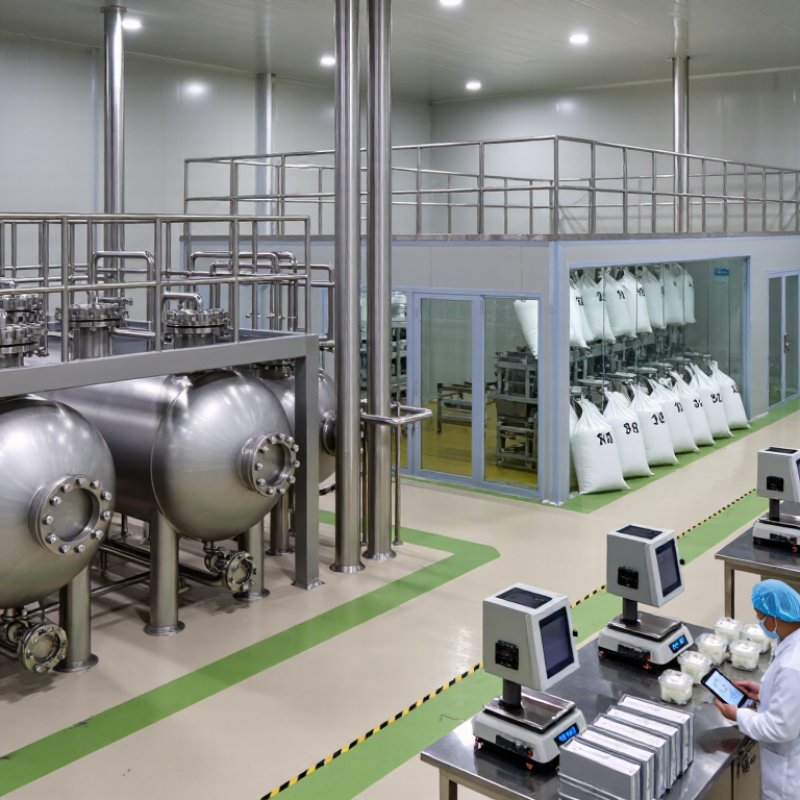
Choosing the best Tech Grade Calcium Formate Factory in China requires more than comparing prices or polished websites. Buyers need evidence from the production floor, not promises alone. Stainless steel reactors, dry packing rooms, calibrated weighing systems, and clearly labeled batch records reveal operational discipline. A reliable factory should explain its raw material sources, reaction controls, drying temperature, particle size, and storage conditions.
Dr. Li Wei, a chemical process consultant with more than 18 years of experience in industrial calcium salts, says, “Consistent calcium formate begins with controlled raw materials, but trust is completed through transparent testing.” His point is practical. A serious supplier should provide recent certificates of analysis, product specifications, safety data, and traceable quality records. Independent laboratory testing can add confidence, especially for construction, feed, leather, or industrial applications.
The strongest Tech Grade Calcium Formate Factory is not always the largest one. It is the factory that consistently meets agreed specifications and responds clearly when a batch falls short. Ask about moisture, purity, water insoluble matter, packaging strength, and production capacity. Visit the site if possible. Watch how workers handle sampling and contamination risks.
No factory is perfect. That matters. A supplier that admits limitations may be more dependable than one claiming universal excellence. Some websites also use “tech grade” loosely, without explaining the actual standard. Buyers should pause there. Compare samples, documentation, audit results, and delivery performance before signing a long-term agreement. Reliable cooperation grows from measurable details, honest communication, and repeated performance.
Calcium Formate: Formula, CAS 544-17-2, and 30.1% Minimum Calcium Content
Calcium formate has the chemical formula Ca(HCOO)₂ and CAS Registry Number 544-17-2. Its molecular weight is approximately 130.11 g/mol, according to the PubChem compound record. Pure anhydrous material contains about 30.8% elemental calcium by calculation. Therefore, a 30.1% minimum specification is chemically plausible, but it requires careful testing.
The number deserves a second look. Moisture, impurities, and analytical methods can reduce measured calcium content. A reliable factory should provide batch-specific certificates, including assay, calcium percentage, water content, pH, and heavy-metal results. Independent laboratory verification is useful, especially when the product enters concrete mixtures or animal-feed applications. Small differences matter.
Industry assessments published by IMARC Group in 2024 identify construction chemicals and nutrition-related applications as important calcium formate demand areas. In practice, technicians often inspect the powder’s color, flowability, and solubility before production use. A uniform white powder is expected, yet appearance alone proves little. ISO 17025 laboratory testing offers stronger evidence than a visual check. Buyers should also compare sampling methods, because one retained bag cannot represent an entire shipment.

Theoretical elemental mass composition of calcium formate, Ca(HCOO)2
Calcium formate has the molecular formula Ca(HCOO)2 and a molar mass of approximately 130.12 g/mol. Based on standard atomic weights, calcium accounts for approximately 30.8% of the compound by mass, which is above the stated 30.1% minimum calcium-content specification. The remaining mass consists of carbon, hydrogen, and oxygen.
Best Tech Grade Calcium Formate Factory in China?
A reliable factory should treat ≥98% purity as a tested result, not a sales phrase. For technical-grade calcium formate, buyers should request batch-specific assay reports, moisture results, and pH records. Moisture must remain ≤0.5%, because damp powder can cake during storage and complicate dosing. The pH target, 6–8, should include the solution concentration and test temperature. Otherwise, the number has limited meaning.
Quality begins on the production floor. Closed transfer lines, calibrated balances, and controlled drying reduce contamination risks. Each batch should be sampled from different bags, not only from the surface. Independent laboratory testing can verify calcium formate content, chloride, insoluble matter, and heavy metals. The 2024 Grand View Research calcium formate market report identifies construction and industrial applications as major demand areas, where consistent performance matters more than a single low quotation. Technical buyers should compare three months of results.
A practical factory audit also checks warehouse conditions. Bags should sit above the floor, away from water, heat, and strong odors. The International Organization for Standardization reports that documented quality systems improve process consistency, but certification alone cannot guarantee product quality. That is worth remembering. A certificate may be current, while one batch still needs investigation. Factories should explain deviations openly and provide corrective-action records. Small details matter: clear labels, sealed packaging, traceable lot numbers, and realistic lead times. The “best” supplier is not always the largest one. It is the one whose data survives careful questions.
Best Tech Grade Calcium Formate Factory in China?
Evaluating a calcium formate factory requires more than reading its advertised annual capacity. Capacity is not output. Request audited production records, reactor volumes, operating shifts, recent yields, and utility data. Compare these figures with shipment history and warehouse movement. A factory producing technical-grade calcium formate should show stable assay, moisture, particle size, and packaging results across multiple batches. The ISO Survey of Management System Standard Certifications 2023 reports more than one million ISO 9001 certificates worldwide, but certification alone does not prove chemical consistency. ISO 9001 verifies a quality management system, not a guaranteed product specification.
Batch traceability deserves closer inspection. Each lot should connect raw-material receipts, weighing records, reactor logs, in-process tests, final laboratory results, packaging codes, and retained samples. Ask whether the factory can retrieve a complete batch file within one working day. That practical test reveals more than a framed certificate. The ICH Q7 quality framework also emphasizes documented material control, production records, laboratory review, and deviation handling, useful benchmarks for chemical suppliers. I have seen evaluations overvalue clean facilities and underestimate record discipline. That is a mistake. A neat floor cannot correct an incomplete batch history. One weakness remains: some suppliers provide impressive certificates but limited evidence from recent production. Independent testing and a witnessed traceability exercise are still worthwhile.
Best Tech Grade Calcium Formate Factory in China?
Choosing a Chinese calcium formate supplier requires more than comparing prices. A reliable factory should provide recent test results for assay, moisture, pH, chloride, and heavy metals. Ask whether testing uses calibrated instruments and an ISO/IEC 17025-accredited laboratory. Request batch samples, not only a standard certificate. Small differences can affect concrete setting and feed applications.
Packaging also deserves close inspection. Common options include 25 kg woven bags with inner PE liners, or 500–1,000 kg jumbo bags. Check bag thickness, stitching, pallet use, and moisture protection. A damaged liner can ruin an otherwise acceptable shipment. The World Bank’s 2023 Logistics Performance Index gave China a score of 3.7 out of 5, yet port congestion and seasonal demand still change delivery schedules. Ask for separate production and shipping lead times. Confirm the MOQ in writing, because “one container” may hide different loading quantities.
Tips: Compare three suppliers using the same test specification. Request a retained sample and a lot-specific COA. Also check whether the quoted price includes pallets, export documents, and inspection fees. In practice, the cheapest offer is not always economical. I would still allow a small timing buffer; planning without one is optimistic, perhaps too optimistic. A factory that answers technical questions clearly is usually easier to manage after payment.
| Anonymous Supplier Profile | Typical Product Specification | Primary Testing Methods | Quality Documentation | Standard Packaging | Indicative Lead Time | Indicative MOQ | Best Fit for Buyers | Key Verification Point |
|---|---|---|---|---|---|---|---|---|
| Profile A: Large-Scale Industrial Producer High-volume focus | Assay: typically ≥98.0% Moisture: typically ≤0.5% Free-flowing white crystalline powder Consistent bulk-lot production | Assay by chemical titration Moisture by oven loss or Karl Fischer method Chloride by argentometric or ion-based testing pH measured in a defined aqueous solution Heavy metals by ICP-OES or ICP-MS when specified | Batch-specific Certificate of Analysis (CoA) Safety Data Sheet (SDS) Packing list and commercial invoice Optional third-party inspection | 25 kg woven polypropylene bags with inner PE liner 500–1,000 kg jumbo bags available for bulk orders Palletized export loading commonly available | Approximately 7–15 working days after order confirmation and deposit, subject to production scheduling | Usually 1 metric ton for regular export orders Larger quantities preferred for customized packaging | Construction additives, concrete accelerators, leather processing, industrial formulations, and distributors | Confirm lot-to-lot assay consistency, moisture control, loading inspection, and the exact net weight per bag |
| Profile B: Export-Oriented Standard Manufacturer Balanced option | Assay: typically ≥98.0% Moisture: commonly ≤0.5–1.0% depending on grade White powder or crystals Standard technical-grade particle profile | Routine assay titration Moisture by drying method pH test using a calibrated pH meter Sulfate and chloride by wet-chemical methods Optional external laboratory confirmation | CoA for each production lot SDS and technical data sheet Sample approval before mass production Export documents available on request | 25 kg PP bags with PE inner bags Kraft paper bags may be available for selected markets Stretch-wrapped pallets for container shipment | Approximately 10–20 working days after specification approval and payment terms are agreed | Commonly 500 kg–1 metric ton Trial orders may be accepted at a higher unit cost | Small and medium distributors, regional construction-chemical buyers, and recurring container purchasers | Compare the approved sample with the shipped lot and verify whether packaging materials meet destination-country requirements |
| Profile C: Flexible Private-Label and Small-Batch Supplier Flexible ordering | Assay: commonly ≥98.0% for technical grade Moisture and particle size may be adjusted by agreement Customized sieve range may be possible Product should be checked against the signed specification | In-house assay and moisture testing Particle-size analysis by sieve method pH testing in aqueous solution Third-party laboratory testing available at buyer’s cost | CoA and SDS generally available Pre-shipment photos and loading records may be provided Third-party inspection can be arranged by contract | 1 kg, 5 kg, or 25 kg bags for samples and small orders 25 kg bags for regular shipment Customized labels and cartons may require additional approval | Approximately 15–30 working days for customized packaging or special particle-size requirements | Often 100–500 kg for standard packing Customized printed packaging may require a higher MOQ | Product trials, laboratory evaluation, online retail preparation, and buyers requiring flexible packing | Confirm whether the supplier is the actual manufacturer or a trading intermediary and request traceable batch records |
| Profile D: Specification-Driven Industrial Supplier Documentation focus | Assay commonly specified at ≥98.0% or higher by contract Controlled moisture limit Defined pH range, chloride limit, sulfate limit, and particle-size distribution Customized acceptance criteria possible | Assay by validated titration method Moisture by Karl Fischer or validated oven method Chloride and sulfate testing against agreed standards Heavy metals by ICP-OES or ICP-MS where required Retained sample and batch traceability procedures | Detailed CoA with test results and specification limits SDS, technical data sheet, and traceability records ISO 9001 documentation may be available Pre-shipment inspection and audit support by agreement | 25 kg moisture-resistant bags with inner liner 500–1,000 kg FIBCs for industrial handling Desiccant or enhanced moisture protection may be specified | Approximately 20–35 working days for first orders, audits, or customized specifications Repeat orders may be shorter | Commonly 1–5 metric tons depending on the approved specification and packaging format | Industrial users with strict incoming inspection, international tenders, and long-term supply contracts | Review the test method, laboratory accreditation where applicable, retention-sample policy, and change-control procedure |
Best Tech Grade Calcium Formate Factory in China?
Selecting a factory requires more than comparing a quoted price. Compliance should be checked through current production licenses, safety records, and export documents. Ask for recent third-party test reports, not only an internal specification sheet. The report should cover purity, moisture, pH, heavy metals, and particle size. A reliable supplier can explain each testing method clearly.
Quality stability matters during repeated deliveries. Request samples from several production batches. Compare color, flowability, packaging condition, and test results. A clean factory should provide batch numbers and retain samples for traceability. During a factory visit, inspect raw material storage, dust control, weighing systems, and laboratory equipment. Details reveal habits. One weakness can matter.
Total cost per ton includes more than the invoice price. Calculate product cost, packaging, inland transport, port charges, inspection fees, payment terms, and possible rejections. A slightly higher price may reduce production interruptions. However, high pricing does not automatically prove better control. I have seen buyers trust attractive certificates while ignoring inconsistent batch data. That judgment deserves reconsideration. Build a comparison sheet with at least three suppliers and use twelve-month performance data when possible. Ask how the factory handles complaints and delayed shipments. Their response often shows more than a sales presentation. Pay attention to practical evidence, not confident promises.